
Navratri colours 2026 are orange, white, red, royal blue, yellow, green, grey, purple and peacock green. Sharad Navratri begins on Sunday, 11 October 2026, and the nine day-wise colours run through Monday, 19 October. Vijayadashami (Dussehra) is on Tuesday, 20 October 2026.
Use this quick guide to find the Navratri 9 colours 2026 with dates, the goddess worshipped each day and the commonly associated meaning of each shade. Colour lists can vary by regional or family custom, so treat this as the widely published calendar and check a local Panchang for location-specific puja timings.
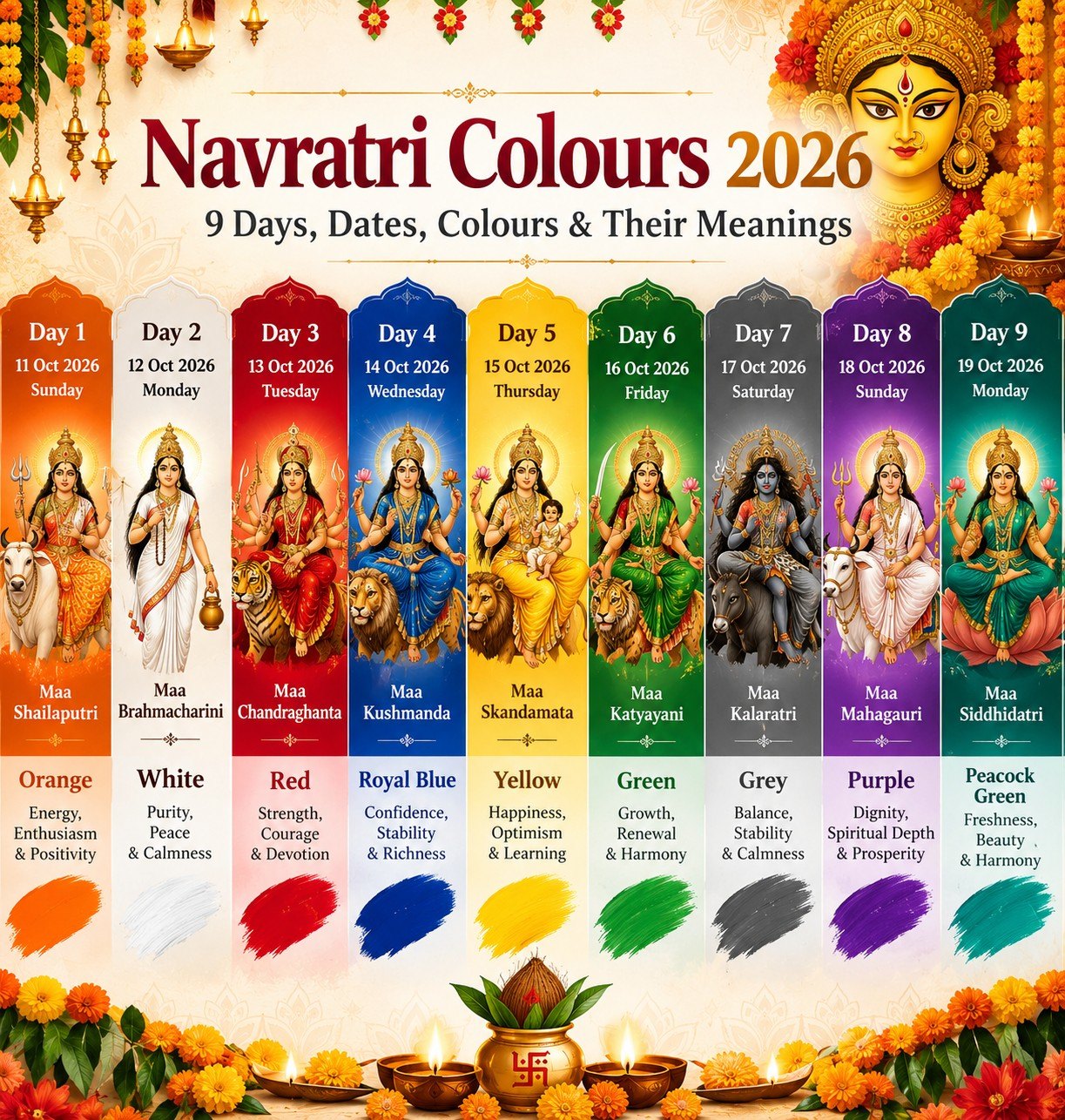
Navratri Colours 2026 at a Glance
- Start date: Sunday, 11 October 2026.
- Day 1 colour: Orange; the day is associated with Maa Shailaputri.
- Nine-colour order: Orange, white, red, royal blue, yellow, green, grey, purple and peacock green.
- Final colour day: Monday, 19 October, associated with Maa Siddhidatri.
- Dussehra: Tuesday, 20 October 2026.
- Wearing a colour is a popular festive custom, not a universal requirement for worship.
Explore the 9 Navratri Colours for 2026
Each day has its own shade. Use this visual colour guide to quickly identify the colour and the goddess associated with each date.
Navratri 2026 Colours: Day-Wise List with Dates and Goddess
This is the main date-wise chart for quick reference. It includes the weekday, colour, form of Goddess Durga and a commonly associated colour meaning.
| Day | Date | Colour | Goddess | Common Meaning |
|---|---|---|---|---|
| Day 1 | Sunday, 11 October | Maa Shailaputri | Energy and enthusiasm | |
| Day 2 | Monday, 12 October | Maa Brahmacharini | Peace and purity | |
| Day 3 | Tuesday, 13 October | Maa Chandraghanta | Courage and strength | |
| Day 4 | Wednesday, 14 October | Maa Kushmanda | Confidence and stability | |
| Day 5 | Thursday, 15 October | Maa Skandamata | Joy and optimism | |
| Day 6 | Friday, 16 October | Maa Katyayani | Growth and renewal | |
| Day 7 | Saturday, 17 October | Maa Kalaratri | Balance and composure | |
| Day 8 | Sunday, 18 October | Maa Mahagauri | Dignity and spiritual depth | |
| Day 9 | Monday, 19 October | Maa Siddhidatri | Freshness and harmony |
Quick answer: The Navratri colour for Sunday, 11 October 2026 is orange. For exact tithi, Ghatasthapana muhurat, Ashtami, Navami or Kanya Puja timings, check a Panchang for your city because ritual timings can vary by location.
What Are the Nine Colours of Navratri?
The widely followed Navratri colour chart for 2026 lists orange, white, red, royal blue, yellow, green, grey, purple and peacock green. Many devotees wear the colour assigned to the day, while others use it in a dupatta, scarf, flowers, rangoli or puja-room decoration. It is a way to take part in the festival’s shared theme; it is not compulsory for everyone.
You may see other colours, including pink, in some Navratri charts. Different regions, organisers and family traditions do not always publish an identical colour sequence. For that reason, use a current-year list and follow the custom familiar to your community.
How Are Navratri Colours Decided?
In a popular colour-calendar tradition, the first colour is associated with the weekday on which Navratri begins. The seven weekday colours are followed by two additional colours to complete the nine-day sequence. Since the festival can start on a different weekday each year, the published order may change.
| Weekday | Common Colour | Traditional Planet Association |
|---|---|---|
| Sunday | Orange | Surya (Sun) |
| Monday | White | Chandra (Moon) |
| Tuesday | Red | Mangal (Mars) |
| Wednesday | Royal Blue | Budh (Mercury) |
| Thursday | Yellow | Guru (Jupiter) |
| Friday | Green | Shukra (Venus) |
| Saturday | Grey | Shani (Saturn) |
This weekday-based explanation describes the popular colour-calendar custom, rather than a universal rule observed by every community. In the widely published 2026 list, the sequence begins with orange because 11 October falls on a Sunday.
Navratri Colours 2026: Meaning of Each Colour
Colour meanings are customary interpretations and can differ across sources. They are useful as a simple guide to the symbolism commonly associated with each day.
Day 1 – Orange: Maa Shailaputri
Orange is commonly associated with energy, warmth and enthusiasm. Maa Shailaputri is worshipped on the first day of Navratri and is often connected with strength, devotion and a steady beginning.
Day 2 – White: Maa Brahmacharini
White represents peace, purity and simplicity in popular colour explanations. Maa Brahmacharini is associated with penance, discipline and devotion.
Day 3 – Red: Maa Chandraghanta
Red is associated with courage, strength, passion and devotion. Maa Chandraghanta is revered as a powerful form of the Goddess linked with courage and protection.
Day 4 – Royal Blue: Maa Kushmanda
Royal blue is often linked with confidence, stability and richness. Maa Kushmanda is associated with creation and vitality in devotional traditions.
Day 5 – Yellow: Maa Skandamata
Yellow is commonly used to represent joy, optimism and brightness. Maa Skandamata is worshipped as the mother of Skanda (Kartikeya) and is associated with maternal care.
Day 6 – Green: Maa Katyayani
Green is associated with growth, renewal and harmony. Maa Katyayani represents strength and the power to overcome obstacles.
Day 7 – Grey: Maa Kalaratri
Grey is often interpreted as balance and composure. Maa Kalaratri is a fierce form of the Goddess associated with protection and overcoming fear.
Day 8 – Purple: Maa Mahagauri
Purple is commonly linked with dignity, spiritual depth and fulfilment. Maa Mahagauri is associated with purity, serenity and grace.
Day 9 – Peacock Green: Maa Siddhidatri
Peacock green blends blue and green tones and is often associated with freshness, harmony and beauty. Maa Siddhidatri is worshipped on the ninth day and is linked with spiritual accomplishment.
The Nine Forms of Goddess Durga (Navadurga)
Each of the nine days is traditionally dedicated to one of the nine forms of Goddess Durga, collectively known as the Navadurga.
| Day | Goddess | Common Association |
|---|---|---|
| 1 | Maa Shailaputri | Strength and devotion |
| 2 | Maa Brahmacharini | Discipline and penance |
| 3 | Maa Chandraghanta | Courage and protection |
| 4 | Maa Kushmanda | Creation and vitality |
| 5 | Maa Skandamata | Maternal care |
| 6 | Maa Katyayani | Strength and fearlessness |
| 7 | Maa Kalaratri | Protection from fear |
| 8 | Maa Mahagauri | Purity and grace |
| 9 | Maa Siddhidatri | Wisdom and spiritual fulfilment |
Navratri 2026 Start Date, End Date and Dussehra
Sharad Navratri’s nine colour days run from Sunday, 11 October through Monday, 19 October 2026. Vijayadashami, also called Dussehra, falls on Tuesday, 20 October 2026. Ghatasthapana (Kalash Sthapana) marks the beginning of the observance on the first day.
Dates for the festival are widely published, but local ritual timings depend on location-specific Panchang calculations. Confirm the muhurat for your city before planning Ghatasthapana or other time-sensitive observances.
What Should You Wear During Navratri 2026?
You do not need to buy nine new outfits. Wear a garment or accessory in the colour of the day, or use the shade in your home celebration if that is easier.
- For puja at home: choose a simple outfit in the day's colour or add a matching dupatta or scarf.
- For Garba and Dandiya: incorporate the colour into your outfit while prioritising comfortable clothing and footwear.
- For work or school: a shirt, ribbon, scarf or small accessory can follow the theme without a full outfit change.
- For families: use the daily colours for simple group photos or children’s festive activities.
- If you miss a colour: there is no need to worry. The custom is meant to be joyful and does not determine your devotion.
How to Use the Daily Colours at Home
Bring the colour of the day into your celebrations through flowers, rangoli, fabric, a chunri or other small decorative details. Use whichever items you already have rather than treating the shade as a compulsory puja ingredient.
| Where to Use It | Simple Ideas |
|---|---|
| Clothing | Kurta, saree, shirt, dupatta, scarf or accessory |
| Puja space | Flowers, a chunri or decorative cloth in a similar shade |
| Rangoli | Use the daily colour as the main shade or as an accent |
| Community events | Coordinate an accessory or outfit for Garba, Dandiya or school events |
| Family celebrations | Choose a colour theme for photos or small decorations |
The exact shade does not have to match perfectly. A similar tone is practical, and there is no need to buy new items simply to follow the colour theme.