
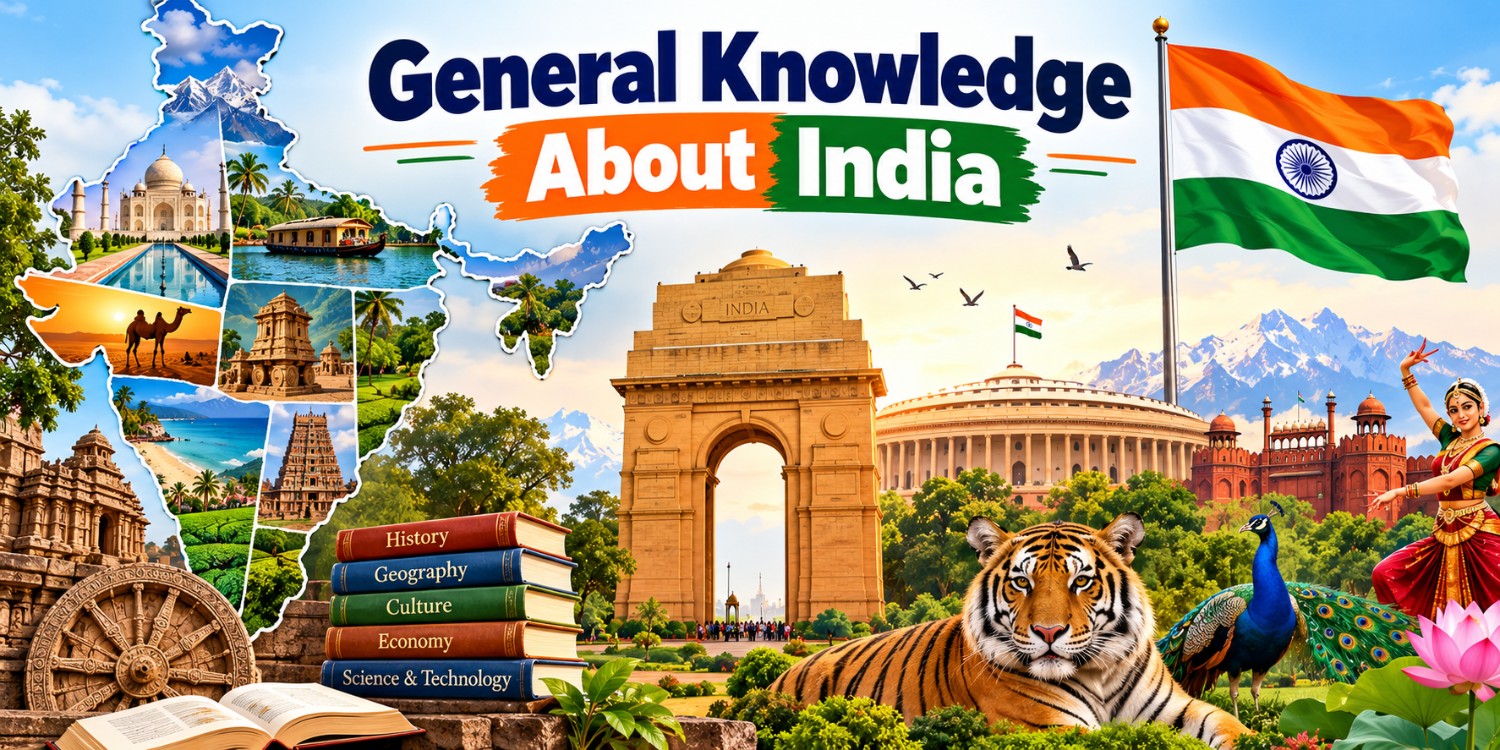
General knowledge about India covers the facts students and quiz learners most often need about Indian geography, history, states and capitals, national symbols, culture, rivers, mountains, monuments, wildlife and important dates. This guide brings the core India GK topics together in one place, with quick-reference tables and explanations so you can revise facts instead of memorising disconnected lists.
Quick answer: India is a South Asian country with 28 states and 8 union territories. New Delhi is the national capital. India became independent on 15 August 1947, its Constitution was adopted on 26 November 1949, and the Constitution came into force on 26 January 1950.
- India at a Glance
- States and Capitals
- Union Territories
- Indian Geography
- Rivers, Mountains and Lakes
- Indian History Timeline
- Culture, Languages and Dances
- National Symbols of India
- Important Places and Heritage
- Wildlife and National Parks
- Important National Dates
- India GK Questions and Answers
- How to Prepare India GK
- Frequently Asked Questions
India at a Glance
India occupies a large part of the Indian subcontinent and has a wide range of physical landscapes, from the Himalayas in the north to peninsular plateaus, coastal plains and island groups. The country borders the Arabian Sea to the west, the Bay of Bengal to the east and the Indian Ocean to the south.
| India GK fact | Answer |
|---|---|
| Country | India (Bharat) |
| Region | South Asia |
| Capital | New Delhi |
| States | 28 |
| Union Territories | 8 |
| Independence Day | 15 August |
| Republic Day | 26 January |
| Constitution Day | 26 November |
| National currency | Indian Rupee (₹) |
| National animal | Bengal Tiger |
| National bird | Indian Peacock |
| National flower | Lotus |
For current administrative information, use the National Portal of India as the primary reference. Administrative details can change, so current exam preparation should use the latest official information.
Indian States and Capitals
India has 28 states. A common India GK question asks students to match each state with its capital. Learning states by region can make the list easier to remember.
| State | Capital | Broad region |
|---|---|---|
| Andhra Pradesh | Amaravati | South India |
| Arunachal Pradesh | Itanagar | Northeast India |
| Assam | Dispur | Northeast India |
| Bihar | Patna | East India |
| Chhattisgarh | Raipur | Central India |
| Goa | Panaji | West India |
| Gujarat | Gandhinagar | West India |
| Haryana | Chandigarh | North India |
| Himachal Pradesh | Shimla | North India |
| Jharkhand | Ranchi | East India |
| Karnataka | Bengaluru | South India |
| Kerala | Thiruvananthapuram | South India |
| Madhya Pradesh | Bhopal | Central India |
| Maharashtra | Mumbai | West India |
| Manipur | Imphal | Northeast India |
| Meghalaya | Shillong | Northeast India |
| Mizoram | Aizawl | Northeast India |
| Nagaland | Kohima | Northeast India |
| Odisha | Bhubaneswar | East India |
| Punjab | Chandigarh | North India |
| Rajasthan | Jaipur | Northwest India |
| Sikkim | Gangtok | Northeast India |
| Tamil Nadu | Chennai | South India |
| Telangana | Hyderabad | South India |
| Tripura | Agartala | Northeast India |
| Uttar Pradesh | Lucknow | North India |
| Uttarakhand | Dehradun | North India |
| West Bengal | Kolkata | East India |
For a dedicated revision list, see Indian States and Capitals.
Union Territories of India
India has 8 union territories. Unlike states, union territories are administered under the constitutional framework for Union Territories, with their administrative arrangements varying by territory.
| Union Territory | Capital / administrative centre |
|---|---|
| Andaman and Nicobar Islands | Sri Vijaya Puram |
| Chandigarh | Chandigarh |
| Dadra and Nagar Haveli and Daman and Diu | Daman |
| Delhi (National Capital Territory) | New Delhi |
| Jammu and Kashmir | Srinagar (summer), Jammu (winter) |
| Ladakh | Leh |
| Lakshadweep | Kavaratti |
| Puducherry | Puducherry |
Because administrative names and arrangements can be updated, verify current details through official government sources before using this table for an examination.
Indian Geography: Major Physical Features
Indian geography is one of the largest India GK topics. The major physical divisions include the Himalayan Mountains, Northern Plains, Peninsular Plateau, Indian Desert, Coastal Plains and Islands.
The Himalayas
The Himalayas form a major mountain system along northern India. They influence climate, river systems and settlement patterns and include some of the world's highest peaks.
The Northern Plains
The Northern Plains are associated with the alluvial deposits of major river systems, including the Ganga, Yamuna and Brahmaputra. Their fertile soils have supported dense agricultural and settlement regions.
The Peninsular Plateau
The Peninsular Plateau covers much of central and southern India. The Deccan Plateau, Western Ghats and Eastern Ghats are important features of peninsular geography.
The Indian Desert and Coastal Plains
The Thar Desert is mainly in Rajasthan. India also has western and eastern coastal plains along the Arabian Sea and Bay of Bengal, with different widths and physical characteristics.
Island Groups
The Andaman and Nicobar Islands lie in the Bay of Bengal region, while Lakshadweep lies in the Arabian Sea. Both are important for Indian geography, biodiversity and maritime geography.
Important Rivers, Mountains and Lakes in India
Rivers, peaks and lakes are frequent topics in India GK questions. Study each one with its location and one distinctive fact instead of memorising names alone.
| Topic | Examples to know | Why it matters in GK |
|---|---|---|
| Major Himalayan rivers | Ganga, Yamuna, Brahmaputra, Indus | Drainage, agriculture and geography |
| Major peninsular rivers | Godavari, Krishna, Kaveri, Narmada, Tapi, Mahanadi | River basins and regional geography |
| Important peaks | Kangchenjunga, Nanda Devi, Kamet | Indian mountain geography |
| Important lakes | Wular, Dal, Chilika, Sambhar, Loktak | Freshwater, saltwater, wetland and regional GK |
Explore the detailed important rivers of India, highest mountains in India and important lakes in India guides for topic-wise revision.
Indian History Timeline
Indian history is easier to revise when organised chronologically. The broad sequence below connects the most commonly studied periods.
| Period | Key topics |
|---|---|
| Ancient India | Indus Valley Civilisation, Vedic traditions, Mahajanapadas, Mauryan and Gupta periods |
| Early and medieval kingdoms | Regional kingdoms, Cholas, Pallavas, Chalukyas, Delhi Sultanate and Vijayanagara |
| Mughal period | Mughal administration, architecture, art and regional political developments |
| Colonial period | East India Company, British rule, economic and administrative changes |
| Freedom movement | Reform movements, Swadeshi, Non-Cooperation, Civil Disobedience, Quit India and independence |
| Independent India | Constitution, democratic institutions, states and economic and social development |
For competitive exams, connect a historical event with its approximate period, important people, location and outcome. This creates a useful mental timeline rather than a collection of isolated dates.
Indian Culture, Languages and Classical Dances
India's cultural diversity is reflected in languages, literature, music, dance, festivals, architecture, crafts and food traditions. The Constitution's Eighth Schedule recognises 22 languages. India also has many other languages and speech varieties used by communities across the country.
| Classical dance | Associated region/tradition |
|---|---|
| Bharatanatyam | Tamil Nadu |
| Kathak | North India |
| Kathakali | Kerala |
| Kuchipudi | Andhra Pradesh |
| Manipuri | Manipur |
| Mohiniyattam | Kerala |
| Odissi | Odisha |
| Sattriya | Assam |
Indian festivals also have strong regional identities. Diwali, Holi, Eid, Christmas, Pongal, Onam, Baisakhi, Bihu and Durga Puja are among the festivals commonly discussed in Indian GK, although their traditions and significance can vary between communities and regions.
National Symbols of India
National symbols are among the most searched and memorised India GK topics. They represent different aspects of India's national identity and are commonly included in school quizzes and general awareness sections.
| National symbol | Answer |
|---|---|
| National Flag | Tricolour with the Ashoka Chakra |
| National Emblem | Lion Capital of Ashoka at Sarnath |
| National Anthem | Jana Gana Mana |
| National Song | Vande Mataram |
| National Animal | Bengal Tiger |
| National Bird | Indian Peacock |
| National Flower | Lotus |
| National Tree | Banyan |
| National Aquatic Animal | Ganges River Dolphin |
| National Fruit | Mango |
See the dedicated National Symbols of India guide for a more detailed revision list.
Important Places, Monuments and Heritage
India's important places include archaeological sites, religious monuments, historic cities, forts, temples and natural landscapes. The Taj Mahal, Agra Fort, Red Fort, Qutb Minar, Ajanta and Ellora Caves, Hampi, Konark and Mahabalipuram are frequently referenced in Indian history and culture questions.
UNESCO's current World Heritage Convention page lists 45 properties inscribed for India, including 37 cultural properties, 7 natural properties and 1 mixed property. The list also includes recent inscriptions such as the Ancient Buddhist Site of Sarnath in 2026 and Maratha Military Landscapes of India in 2025.
Do not confuse the World Heritage List with India's Tentative List. UNESCO currently lists 78 Indian properties on the Tentative List; these are not the same as properties already inscribed on the World Heritage List.
For heritage GK, remember the place, state, broad historical period and why the site is notable. This is more useful for quizzes than memorising names alone.
Indian Wildlife and National Parks
India has diverse ecosystems ranging from Himalayan habitats and forests to wetlands, deserts, mangroves and coastal environments. National parks, wildlife sanctuaries and tiger reserves are important topics for geography and environment GK.
| Protected area | State / region | Known for |
|---|---|---|
| Kaziranga National Park | Assam | One-horned rhinoceros and wetland-grassland ecosystem |
| Gir National Park | Gujarat | Asiatic lion |
| Jim Corbett National Park | Uttarakhand | Terai and Himalayan foothill wildlife |
| Ranthambore National Park | Rajasthan | Tiger habitat |
| Sundarbans National Park | West Bengal | Mangrove ecosystem and Bengal tiger habitat |
| Kanha National Park | Madhya Pradesh | Central Indian forest ecosystem |
For a larger list, use the dedicated National Parks in India guide.
Important National Dates
| Date | Event |
|---|---|
| 26 January | Republic Day |
| 15 August | Independence Day |
| 2 October | Gandhi Jayanti |
| 26 November | Constitution Day |
| 14 April | Ambedkar Jayanti |
| 5 September | Teachers' Day in India |
| 14 November | Children's Day in India |
Dates can represent different kinds of observances, so distinguish national days, government observances, commemorative days and international days when preparing for an exam.
India GK Questions and Answers
1. What is the capital of India?
New Delhi.
2. How many states are there in India?
28 states.
3. How many union territories are there in India?
8 union territories.
4. When did India become independent?
15 August 1947.
5. When was the Constitution of India adopted?
26 November 1949.
6. When did the Constitution of India come into force?
26 January 1950.
7. What is India's national animal?
The Bengal Tiger.
8. What is India's national bird?
The Indian Peacock.
9. Which is India's national aquatic animal?
The Ganges River Dolphin.
10. Which Indian site was inscribed as a UNESCO World Heritage property in 2026?
The Ancient Buddhist Site of Sarnath was inscribed in 2026. UNESCO's India page provides the current World Heritage List.
How to Prepare General Knowledge About India
For school quizzes and competitive exams, divide India GK into manageable clusters: states and capitals, geography, history, polity basics, national symbols, culture, environment, important places and current affairs. Revise one cluster at a time and use maps and tables wherever possible.
- Start with static GK: learn states, capitals, symbols, rivers, mountains and major places.
- Build a history timeline: connect periods, events, people and places.
- Use maps: locate rivers, mountains, states, neighbouring countries and important heritage sites.
- Separate static and current GK: administrative changes and new records should be checked against current official sources.
- Practise questions: test recall instead of repeatedly reading the same list.
For topic-wise learning, continue with Indian States and Languages, Major Dams in India, Important Lakes in India and Highest Mountains in India.
Frequently Asked Questions
What is general knowledge about India?
India GK is the study of important facts about India's geography, history, states, capitals, culture, national symbols, environment, monuments, institutions and important dates.
What are the most important India GK topics?
Start with states and capitals, Indian geography, history, national symbols, rivers and mountains, culture, important places, wildlife and important national dates.
How many states and union territories are there in India?
India currently has 28 states and 8 union territories. Verify administrative details against the latest official government information when preparing for an examination.
What are the national symbols of India?
Commonly studied national symbols include the Tricolour, State Emblem, National Anthem, National Song, Bengal Tiger, Indian Peacock, Lotus, Banyan and Ganges River Dolphin.
Which Indian topics are important for school GK quizzes?
States and capitals, national symbols, important rivers, mountains, monuments, historical events, festivals, classical dances and famous national parks are useful starting points.
How can I remember Indian GK facts easily?
Group facts by topic and region, use tables and maps, create short revision notes and practise questions regularly. Context-based memory is usually easier than isolated memorisation.
How often should I update India GK?
Static facts can remain useful for years, but administrative details, records, protected-area information and current events should be checked against current official sources.
Related India GK Guides
Continue your revision with Indian States and Capitals, Indian States and Languages, National Symbols of India, National Parks in India, Important Rivers of India, Major Dams in India, Important Lakes in India and Highest Mountains in India.
Source note: For current facts, refer to the National Portal of India and relevant government departments. For World Heritage status, refer to UNESCO's India profile.