
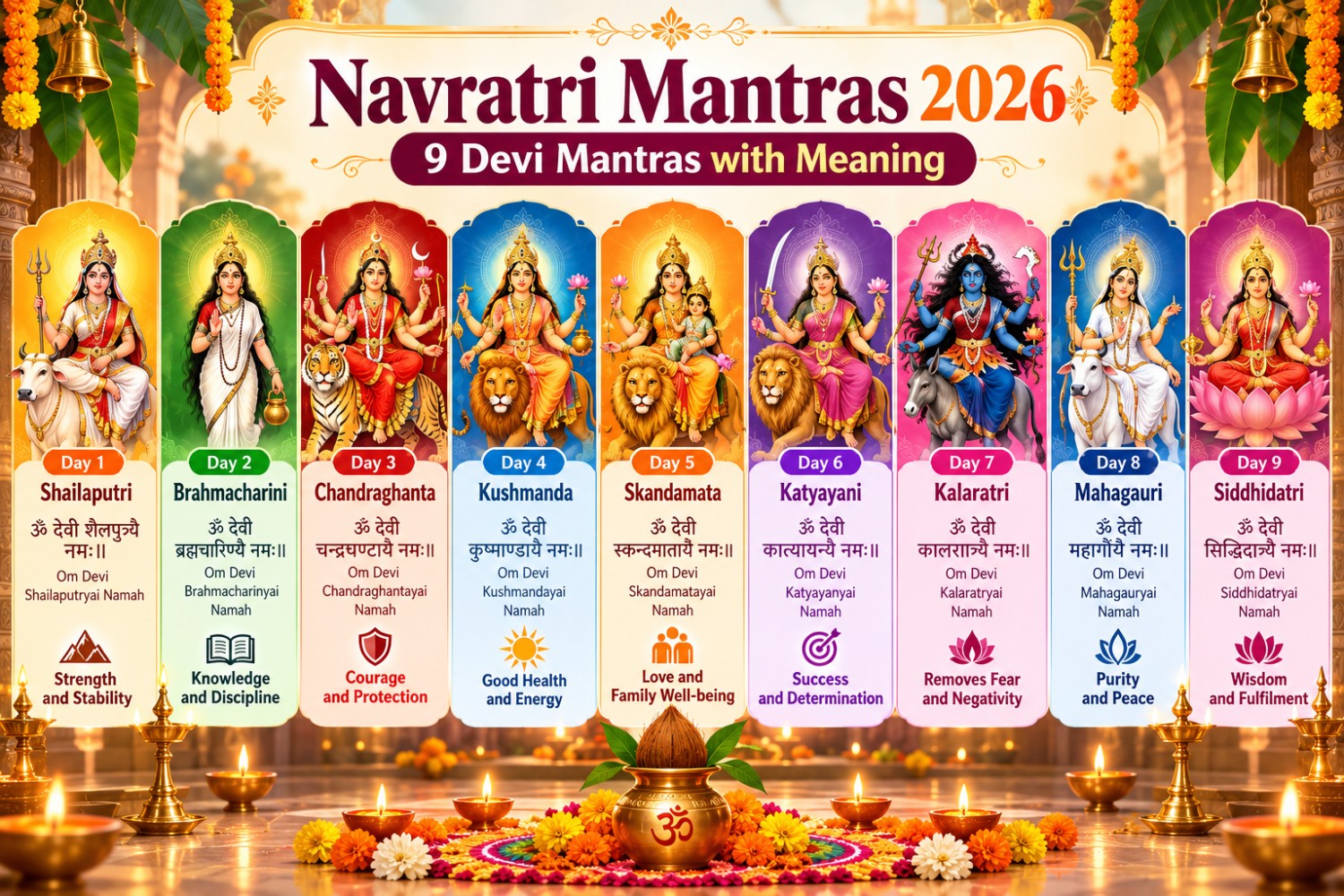
Sharad Navratri honours the nine forms of Maa Durga, collectively known as the Navadurga. This guide brings together the 9 Navratri mantras for 2026 in Sanskrit, with simple transliteration, plain-English meaning and the day-wise Goddess sequence.
How to use this guide
Read the Sanskrit mantra, use the transliteration as a pronunciation aid, and follow the worship practice of your family or tradition. For exact ritual timings or pronunciation, refer to a trusted local Panchang, priest or traditional recitation.
For the commonly followed 2026 sequence, Sharad Navratri begins on Sunday, October 11. The nine Navadurga days run through Monday, October 19, followed by Vijayadashami on Tuesday, October 20. Lunar-tithi timings and some regional observances can vary by location.
Navratri 2026 Day-wise Mantra Schedule
| Day | Date | Navadurga form | Name mantra |
|---|---|---|---|
| Day 1 | Oct 11, Sunday | Shailaputri | ॐ देवी शैलपुत्र्यै नमः॥ |
| Day 2 | Oct 12, Monday | Brahmacharini | ॐ देवी ब्रह्मचारिण्यै नमः॥ |
| Day 3 | Oct 13, Tuesday | Chandraghanta | ॐ देवी चन्द्रघण्टायै नमः॥ |
| Day 4 | Oct 14, Wednesday | Kushmanda | ॐ देवी कूष्माण्डायै नमः॥ |
| Day 5 | Oct 15, Thursday | Skandamata | ॐ देवी स्कन्दमातायै नमः॥ |
| Day 6 | Oct 16, Friday | Katyayani | ॐ देवी कात्यायन्यै नमः॥ |
| Day 7 | Oct 17, Saturday | Kalaratri | ॐ देवी कालरात्र्यै नमः॥ |
| Day 8 | Oct 18, Sunday | Mahagauri | ॐ देवी महागौर्यै नमः॥ |
| Day 9 | Oct 19, Monday | Siddhidatri | ॐ देवी सिद्धिदात्र्यै नमः॥ |
Day 1: Maa Shailaputri Mantra
Maa Shailaputri
Om Devi Shailaputryai Namah
Meaning: Salutations to Goddess Shailaputri, revered as the daughter of the mountains.
Maa Brahmacharini
Om Devi Brahmacharinyai Namah
Meaning: Salutations to Goddess Brahmacharini, associated with devotion, discipline and spiritual resolve.
Maa Chandraghanta
Om Devi Chandraghantayai Namah
Meaning: Salutations to Goddess Chandraghanta, whose name refers to the crescent-moon bell associated with her form.
Maa Kushmanda
Om Devi Kushmandayai Namah
Meaning: Salutations to Goddess Kushmanda, traditionally associated with the cosmic creation and radiance.
Maa Skandamata
Om Devi Skandamatayai Namah
Meaning: Salutations to Goddess Skandamata, the mother of Skanda (Kartikeya).
Maa Katyayani
Om Devi Katyayanyai Namah
Meaning: Salutations to Goddess Katyayani, a revered form of Durga associated with courage and strength.
Maa Kalaratri
Om Devi Kalaratryai Namah
Meaning: Salutations to Goddess Kalaratri, a fierce form revered as a protector against darkness and fear.
Maa Mahagauri
Om Devi Mahagauryai Namah
Meaning: Salutations to Goddess Mahagauri, whose form is associated with purity and serenity.
Maa Siddhidatri
Om Devi Siddhidatryai Namah
Meaning: Salutations to Goddess Siddhidatri, whose name is associated with the bestowal of spiritual accomplishments or siddhis.
How to Chant Navratri Mantras
There is no single routine followed by every household. If it fits your tradition, you can sit in a clean, quiet place, take a moment to focus, read the mantra slowly and repeat it with attention. Some devotees recite the mantra associated with that day; others follow a family prayer, a stotra or guidance from a spiritual teacher.
These are devotional name mantras and short explanations of their commonly understood meanings. This page does not promise specific outcomes from chanting; beliefs and spiritual experiences are personal.
Explore More Navratri Guides
Frequently Asked Questions
What are the nine Navratri mantras?
They are commonly recited name mantras for Maa Shailaputri, Brahmacharini, Chandraghanta, Kushmanda, Skandamata, Katyayani, Kalaratri, Mahagauri and Siddhidatri.
Can I chant a Navratri mantra without knowing Sanskrit?
You can use the transliteration as a starting aid. For careful pronunciation, listen to a trusted recitation or seek guidance from a knowledgeable teacher.
How many times should I chant a mantra?
Practices differ by family and tradition. Some people recite it once or a few times, while others follow a traditional count. Choose a practice that is comfortable and appropriate for you.
Which Goddess is worshipped on each Navratri day?
A commonly followed sequence begins with Shailaputri and continues through Brahmacharini, Chandraghanta, Kushmanda, Skandamata, Katyayani, Kalaratri, Mahagauri and Siddhidatri. Local customs may vary.
Are these mantras guaranteed to bring a specific result?
No specific outcome can be guaranteed. This guide shares devotional mantras and their commonly understood meanings; beliefs and experiences are personal.
For the day-wise festival colours, see our Navratri Colours 2026 guide. For greetings to share with loved ones, explore Navratri wishes, messages and WhatsApp status.