
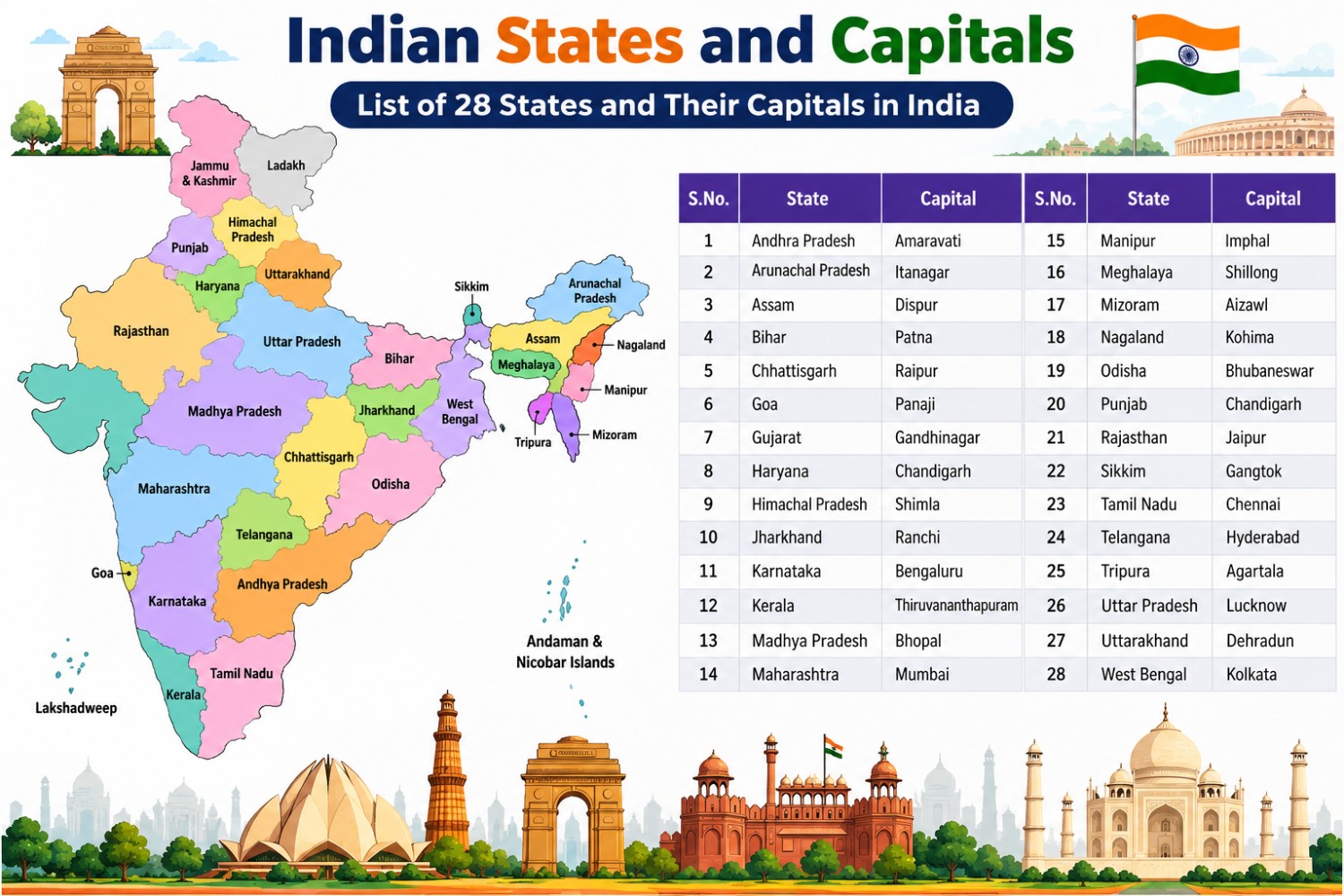
India has 28 states, and each state has a capital that serves as an important administrative centre. Learning the state-capital pairs is a basic but high-frequency topic in Indian geography, school quizzes, general awareness and competitive-exam preparation.
This guide gives the 28 states of India and their capitals in a simple table, followed by regional groupings, important facts, revision tips and frequently asked questions. India also has 8 Union Territories; they are covered separately so that state and Union Territory lists are not mixed.
28 States and Capitals of India
The current national structure comprises 28 states and 8 Union Territories. The list below focuses only on the 28 states. Capital arrangements can have special administrative or seasonal provisions in some states, so official state government information should be used when a question specifically asks about a seasonal or secondary capital.
| No. | State | Capital |
|---|---|---|
| 1 | Andhra Pradesh | Amaravati |
| 2 | Arunachal Pradesh | Itanagar |
| 3 | Assam | Dispur |
| 4 | Bihar | Patna |
| 5 | Chhattisgarh | Raipur |
| 6 | Goa | Panaji |
| 7 | Gujarat | Gandhinagar |
| 8 | Haryana | Chandigarh |
| 9 | Himachal Pradesh | Shimla |
| 10 | Jharkhand | Ranchi |
| 11 | Karnataka | Bengaluru |
| 12 | Kerala | Thiruvananthapuram |
| 13 | Madhya Pradesh | Bhopal |
| 14 | Maharashtra | Mumbai |
| 15 | Manipur | Imphal |
| 16 | Meghalaya | Shillong |
| 17 | Mizoram | Aizawl |
| 18 | Nagaland | Kohima |
| 19 | Odisha | Bhubaneswar |
| 20 | Punjab | Chandigarh |
| 21 | Rajasthan | Jaipur |
| 22 | Sikkim | Gangtok |
| 23 | Tamil Nadu | Chennai |
| 24 | Telangana | Hyderabad |
| 25 | Tripura | Agartala |
| 26 | Uttar Pradesh | Lucknow |
| 27 | Uttarakhand | Dehradun |
| 28 | West Bengal | Kolkata |
Indian States by Region
Regional grouping makes the state-capital list easier to revise. These groups are geographic study aids rather than formal constitutional categories.
| Region | States |
|---|---|
| North India | Haryana, Himachal Pradesh, Punjab, Rajasthan, Uttar Pradesh, Uttarakhand |
| South India | Andhra Pradesh, Karnataka, Kerala, Tamil Nadu, Telangana |
| East India | Bihar, Jharkhand, Odisha, West Bengal |
| West India | Goa, Gujarat, Maharashtra, Rajasthan |
| Central India | Chhattisgarh, Madhya Pradesh |
| Northeast India | Arunachal Pradesh, Assam, Manipur, Meghalaya, Mizoram, Nagaland, Sikkim, Tripura |
Regional boundaries used in school geography can differ slightly, and Rajasthan is sometimes grouped with North India as well as West India. For revision, use the grouping followed by your textbook or examination authority.
Important Capital-Related Facts
Chandigarh is the capital of two states
Chandigarh serves as the capital of both Haryana and Punjab. It is also a Union Territory, making it a frequent general-knowledge question.
Amaravati and Andhra Pradesh
Amaravati is the capital associated with Andhra Pradesh in the current state-capital list. Capital-related developments have changed over time, so older study material can contain different arrangements. For current examination preparation, use the latest official Andhra Pradesh government information.
Dehradun and Uttarakhand
Dehradun is commonly listed as the capital of Uttarakhand. Uttarakhand also has Gairsain (Bhararisain) as the summer capital under state government arrangements. If an exam asks specifically for the state capital in a standard one-answer format, check the wording and prescribed source.
Shimla and Himachal Pradesh
Shimla is the commonly listed capital of Himachal Pradesh. The state has also used Dharamshala as a second capital under state government notification, so questions about “capital” and “second capital” should be read carefully.
States vs Union Territories
States and Union Territories are both parts of the Indian Union, but their constitutional and administrative arrangements differ. India currently has 28 states and 8 Union Territories. The National Portal of India lists the 8 Union Territories as Andaman and Nicobar Islands, Chandigarh, Dadra and Nagar Haveli and Daman and Diu, Delhi, Jammu and Kashmir, Ladakh, Lakshadweep and Puducherry.
| Union Territory | Capital / administrative centre |
|---|---|
| Andaman and Nicobar Islands | Sri Vijaya Puram |
| Chandigarh | Chandigarh |
| Dadra and Nagar Haveli and Daman and Diu | Daman |
| Delhi (NCT) | New Delhi |
| Jammu and Kashmir | Srinagar (summer), Jammu (winter) |
| Ladakh | Leh |
| Lakshadweep | Kavaratti |
| Puducherry | Puducherry |
Note: Union Territory administrative arrangements can be described differently in official sources, especially where seasonal offices or administrative centres are involved. Use the latest official source for current-affairs questions.
Indian States and Capitals: Important GK Questions
| Question | Answer |
|---|---|
| How many states are there in India? | 28 states. |
| How many Union Territories are there in India? | 8 Union Territories. |
| Which state has Amaravati as its capital? | Andhra Pradesh. |
| Which state has Itanagar as its capital? | Arunachal Pradesh. |
| Which state has Dispur as its capital? | Assam. |
| Which two states share Chandigarh as their capital? | Haryana and Punjab. |
| What is the capital of Karnataka? | Bengaluru. |
| What is the capital of Kerala? | Thiruvananthapuram. |
| What is the capital of Odisha? | Bhubaneswar. |
| What is the capital of Sikkim? | Gangtok. |
| What is the capital of Tamil Nadu? | Chennai. |
| What is the capital of Telangana? | Hyderabad. |
| What is the capital of West Bengal? | Kolkata. |
How to Memorise Indian States and Capitals
The easiest approach is to learn capitals in regional groups instead of memorising all 28 pairs at once.
- Start with the five southern states and their capitals.
- Learn the eight northeastern states as one group.
- Revise North, East, West and Central India separately.
- Remember special cases such as Chandigarh being shared by Haryana and Punjab.
- Use a blank India map to connect each state with its capital.
- Revise the 28-state table regularly and check official sources when a capital arrangement is subject to a recent administrative change.
One-Minute Revision List
South: Andhra Pradesh–Amaravati; Karnataka–Bengaluru; Kerala–Thiruvananthapuram; Tamil Nadu–Chennai; Telangana–Hyderabad.
Northeast: Arunachal Pradesh–Itanagar; Assam–Dispur; Manipur–Imphal; Meghalaya–Shillong; Mizoram–Aizawl; Nagaland–Kohima; Sikkim–Gangtok; Tripura–Agartala.
East: Bihar–Patna; Jharkhand–Ranchi; Odisha–Bhubaneswar; West Bengal–Kolkata.
West: Goa–Panaji; Gujarat–Gandhinagar; Maharashtra–Mumbai; Rajasthan–Jaipur.
North/Central: Haryana–Chandigarh; Himachal Pradesh–Shimla; Punjab–Chandigarh; Uttar Pradesh–Lucknow; Uttarakhand–Dehradun; Chhattisgarh–Raipur; Madhya Pradesh–Bhopal.
Frequently Asked Questions
How many states are there in India?
India has 28 states and 8 Union Territories.
How many Union Territories are there in India?
India currently has 8 Union Territories.
Which two states have Chandigarh as their capital?
Haryana and Punjab share Chandigarh as their capital. Chandigarh is also a Union Territory.
What is the capital of Andhra Pradesh?
Amaravati is the capital associated with Andhra Pradesh in the current state-capital list. Check the latest state government source for current administrative developments.
What is the capital of Karnataka?
Bengaluru is the capital of Karnataka.
What is the capital of Kerala?
Thiruvananthapuram is the capital of Kerala.
What is the capital of Odisha?
Bhubaneswar is the capital of Odisha.
What is the capital of Uttarakhand?
Dehradun is commonly listed as the capital of Uttarakhand. Gairsain (Bhararisain) has the status of summer capital under state government arrangements.
What is the capital of Himachal Pradesh?
Shimla is the commonly listed capital of Himachal Pradesh; Dharamshala has been designated as a second capital.
Related General Knowledge Guides
Continue your India GK revision with General Knowledge About India, Indian States and Languages, Union Territories of India, Important Rivers of India and Important Lakes in India.
Source note: The page uses the current national structure of 28 states and 8 Union Territories. Capital arrangements that have special, seasonal or second-capital provisions should be checked against the relevant state government or National Portal of India source when preparing for a current-affairs question.